
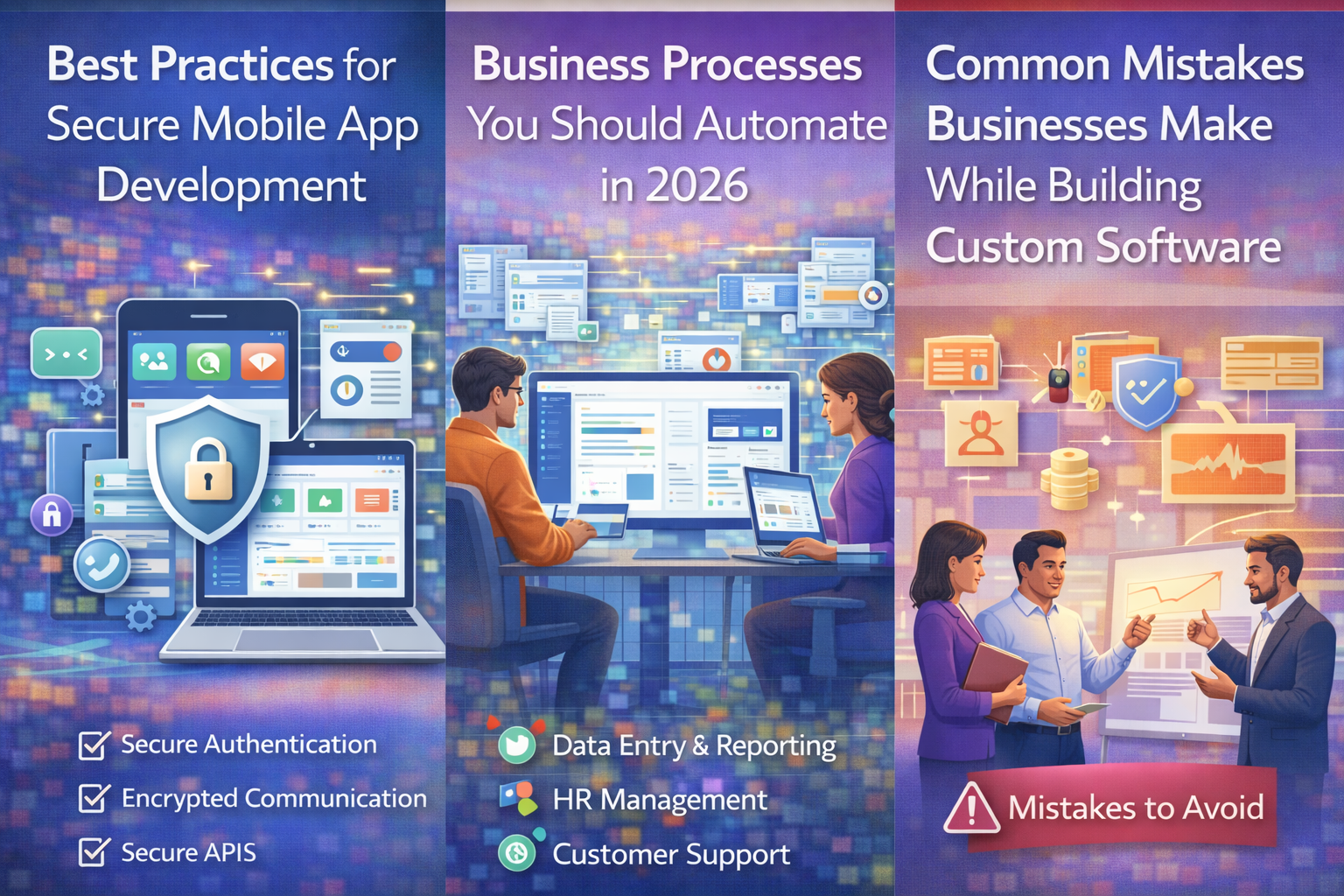
Best Practices for Secure Mobile App Development
Introduction: Why Mobile App Security Is a Business Priority
Mobile applications are no longer just digital products—they are critical business assets. From fintech and e-commerce to healthcare and enterprise platforms, mobile apps handle sensitive user data, financial transactions, and operational workflows.
A single security vulnerability can result in:
- Data breaches
- Financial loss
- Regulatory penalties
- Permanent damage to brand trust
Secure mobile app development is not just a technical concern—it is a business risk management strategy.
Understanding the Mobile App Threat Landscape
Before implementing security measures, businesses must understand common threats:
- Insecure APIs
- Weak authentication mechanisms
- Data leakage via local storage
- Reverse engineering and code tampering
- Man-in-the-middle (MITM) attacks
- Malware and third-party SDK vulnerabilities
Modern attackers target both frontend apps and backend systems, making end-to-end security essential.
Core Principles of Secure Mobile App Development
1️⃣ Security-by-Design Approach
Security should be integrated from the planning phase, not added after development.
Key actions:
- Threat modelling during requirement analysis
- Secure architecture planning
- Risk assessment for user data and APIs
Authentication & Identity Management Best Practices
2️⃣ Strong Authentication Mechanisms
- Implement multi-factor authentication (MFA)
- Use secure token-based authentication (OAuth 2.0, JWT)
- Avoid custom authentication logic where possible
3️⃣ Role-Based Access Control (RBAC)
- Define roles clearly (admin, user, manager, etc.)
- Restrict access to sensitive features
- Enforce least-privilege access
Why this matters: Even authenticated users should not have unrestricted access.
Data Protection & Encryption
4️⃣ Encrypt Data at Rest
- Use platform-secure storage:
- Android Keystore
- iOS Keychain
- Avoid storing passwords, tokens, or PII in plain text
5️⃣ Encrypt Data in Transit
- Enforce HTTPS with TLS 1.2+
- Implement certificate pinning
- Block insecure network connections
Backend & API Security
6️⃣ Secure API Design
APIs are the most common attack surface.
Best practices:
- Input validation on all requests
- API authentication & authorisation
- Rate limiting & throttling
- IP filtering where applicable
7️⃣ Protect Against API Abuse
- Monitor abnormal request patterns
- Log failed authentication attempts
- Implement API gateways for enterprise apps
Secure Coding Practices
8️⃣ Input Validation & Sanitisation
- Prevent SQL injection
- Protect against XSS and CSRF
- Validate both client-side and server-side inputs
9️⃣ Dependency & Library Management
- Avoid outdated SDKs
- Monitor third-party library vulnerabilities
- Remove unused dependencies
App Hardening & Reverse Engineering Protection
🔟 Code Obfuscation
- Obfuscate application code
- Remove debug logs
- Disable debugging in production builds
1️⃣1️⃣ Runtime Protection
- Detect rooted or jailbroken devices
- Monitor runtime integrity
- Block suspicious behaviour
Security Testing & Maintenance
1️⃣2️⃣ Regular Security Testing
- Static Application Security Testing (SAST)
- Dynamic Application Security Testing (DAST)
- Penetration testing
- Automated vulnerability scans
1️⃣3️⃣ Continuous Updates & Monitoring
- Patch vulnerabilities regularly
- Monitor security logs
- Stay compliant with regulations (GDPR, HIPAA, PCI-DSS)
Conclusion
Secure mobile app development is an ongoing lifecycle, not a one-time checklist. Businesses that prioritise security gain:
- User trust
- Regulatory compliance
- Long-term scalability
- Competitive advantage