Business Processes You Should Automate in 2026
Introduction: Why Automation Is No Longer Optional
Businesses in 2026 face increasing pressure to operate faster, leaner, and smarter. Manual workflows slow growth, introduce errors, and limit scalability.
Automation is no longer about saving time—it is about business survival and growth.
The Business Impact of Manual Processes
Manual operations lead to:
- Higher operational costs
- Delayed decision-making
- Human errors
- Limited scalability
- Employee burnout
Automation eliminates these bottlenecks.
High-Impact Business Processes to Automate
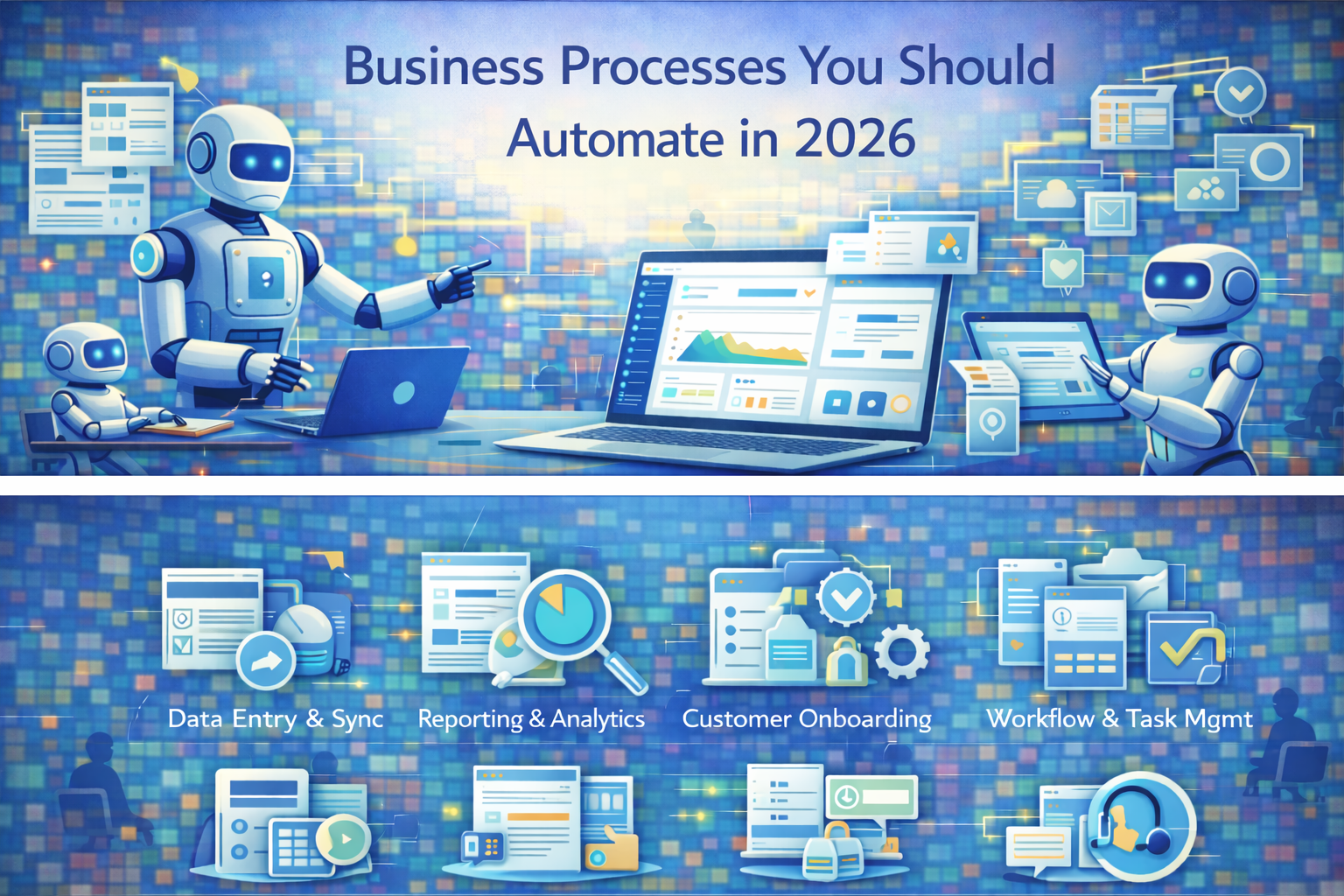
1️⃣ Data Entry & Data Synchronisation
Manual data entry across multiple systems causes inconsistencies.
Automation enables:
- Real-time syncing
- Single source of truth
- Reduced human error
2️⃣ Reporting & Business Intelligence
Automated reporting provides:
- Live dashboards
- Scheduled reports
- Predictive analytics
Result: Faster strategic decisions.
3️⃣ Customer Onboarding & Verification
Automate:
- User registration
- Document verification
- Account setup
- Welcome workflows
This reduces onboarding friction and drop-offs.
4️⃣ Workflow & Task Automation
Examples:
- Automatic task assignment
- SLA tracking
- Escalation workflows
- Status notifications
5️⃣ Finance & Accounting Processes
Automation areas:
- Invoice generation
- Payment tracking
- Expense approvals
- Reconciliation
6️⃣ HR & Workforce Management
Automate:
- Attendance & leave management
- Payroll calculations
- Employee onboarding
- Performance reporting
7️⃣ Customer Support Operations
Automation improves:
- Ticket routing
- Auto-responses
- Issue prioritisation
- Knowledge base suggestions
8️⃣ Inventory & Operations Management
Automated systems:
- Track inventory levels
- Trigger reorders
- Forecast demand
Benefits of Automation in 2026
- Reduced operational costs
- Improved accuracy
- Faster execution
- Better compliance
- Scalability without hiring pressure
Conclusion
Businesses that automate the right processes gain agility, resilience, and long-term growth. Automation is no longer a luxury—it’s a competitive necessity.